
What is advanced practice?

Health Education England (HEE) defines advanced practice as a defined level of practice within clinical professions such as nursing, pharmacy, paramedics and occupational therapy. This level of practice is designed to transform and modernise pathways of care, enabling the safe and effective sharing of skills across traditional professional boundaries.
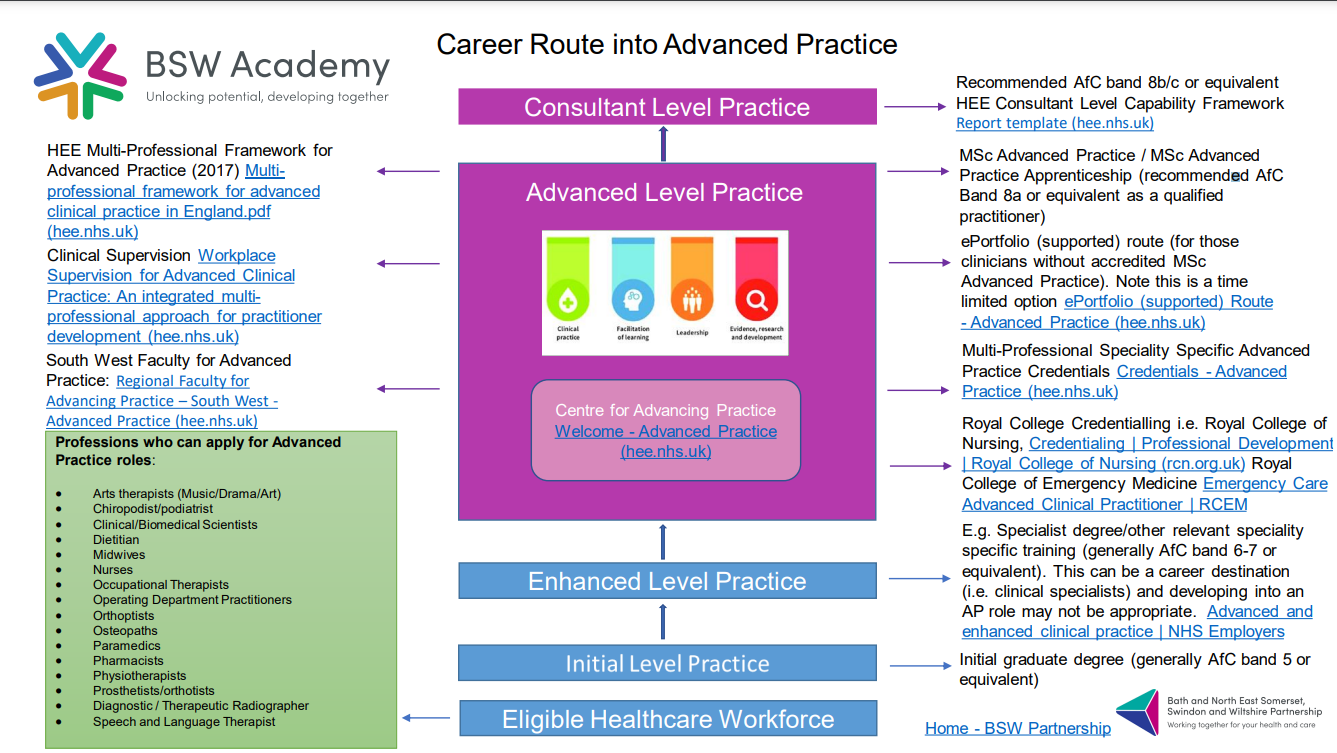
Resources for Advanced Practice

HEE have developed a range of resources including a Multi-professional framework for advanced practice in England which can be helpful to understand how the role works.

HEE have also developed a supervision framework setting out seven fundamental considerations which underpin supervision in advanced clinical practice.

View information and supporting links for those seeking to undertake Supported e-portfolio Route for recognition of level of education and training equivalence.

Advanced Practice Toolkit contains information and resources suitable for both employers, commissioners and clinicians.

BSW Implementation Guide – This guide aims to ensure all health and social care providers within BSW ICS who employ trainee ACP (tACP) or qualified Advanced Clinical Practitioners (ACP), develop these roles with a consistent and transparent approach.

BSW ICB workforce transformation leads have authored a Memorandum of Understanding document that contains the recommended minimum standards for qualified and trainee ACPs.

Access local South West support for all advanced practice topics.

Credentials

Multi-professional advanced practice credentials are an important component of developing a responsive, flexible workforce to meet changing population, patient and service delivery needs. Credentials’ development, delivery and take-up should increase advanced practice capability and capacity. In turn, this should support sustainable, high-quality approaches to meeting population needs and deliver patient benefit. 

Day in the life Case Study

Neal Aplin wrote an article for Nursing Older People Journal which offered a reflective account of advanced clinical practice in an older person’s unit specialising in rehabilitation and complex discharge planning. The article illustrated how APs can work autonomously with medical colleagues to provide patient-focused care, enhance the multidisciplinary team and provide safe, high-quality care. 

Supported e-portfolio

The HEE Centre for Advancing Practice supported e-portfolio is now open. Expressions of interest have been taken for cohort 2 and EOI for cohort 3 will be open in 2023. Find out more

Portfolios require collecting a range of evidence from work-based experiences and reflections. Your own professional body may have a portfolio system, or recommended documents, but if not, useful documents e.g. case based discussions (CbD), Mini clinical evaluation exercise (mini-CEX), Multi-course feedback (MSF), and Patient Surveys (PSF), and others, can be found at the Joint Royal Colleges of Physicians Training Board.

Advanced Practice examples from BSW

Lucy Moxham evaluated the impact of advanced nurse practitioner triage on the management of medically expected patients referred to an acute National Health Service hospital.


Frailty teams, including ACP nurses, were able to assess drug burden and reduce the cholinergic drug burden of people being admitted through A&E. This was most notable in mild to moderate frailty groups.


John Taylor and team discuss establishing MDT management of chest pain, including ACP roles, reducing the use of CT angiograms, inpatient admissions, and increased the discharge of people with low risk chest pain from emergency departments.